

What is macular oedema?
The macula is the small central part of the retina that gives you sharp, detailed vision. In macular oedema, leaky blood vessels let fluid collect in it, so it swells like a wet sponge. Side vision is usually fine, but the centre goes blurry.
Common symptoms
- Blurred or smudged central vision that glasses don't fix
- Straight lines, such as door frames or tiles, look bent or wavy
- Words drop out or look patchy when reading
- Colours look washed out
Some people notice nothing at first, especially if the other eye is still good. Diabetic macular oedema is often first picked up at a routine diabetic eye check.
What causes macular oedema?
Diabetic macular oedema
The most common cause. Years of high blood sugar damage the tiny vessels of the retina, and they start to leak. It can happen at any stage of diabetic retinopathy, even when the rest of the retina looks fairly mild.
Retinal vein occlusion
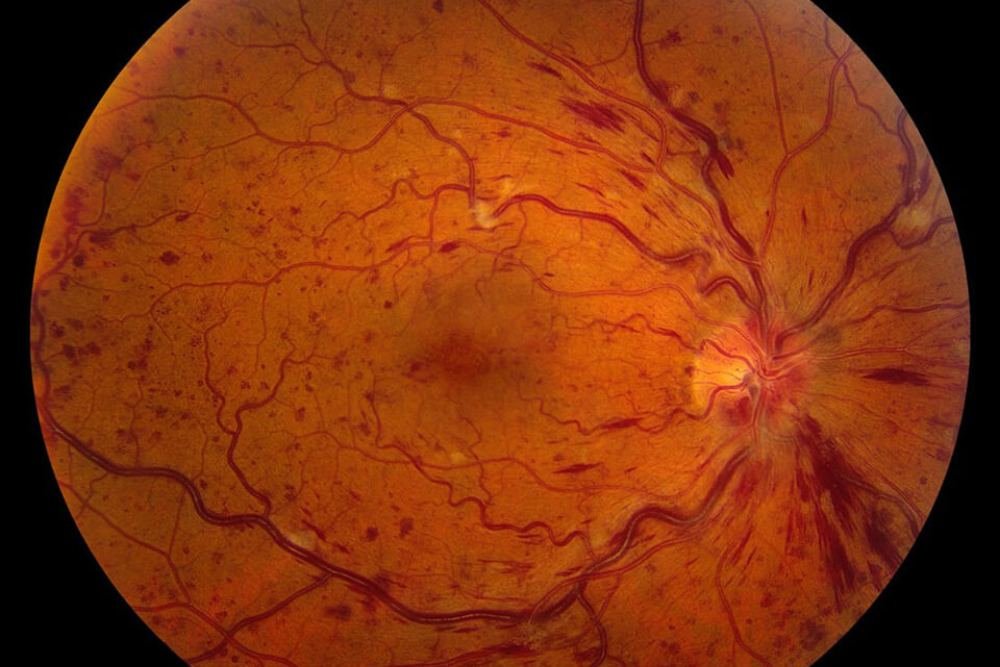
A blockage in one of the veins draining the retina, often linked to high blood pressure, high cholesterol, diabetes or glaucoma. Blood backs up and fluid leaks into the macula, sometimes causing a sudden drop in vision in one eye.
Other causes
Macular oedema can also follow eye inflammation (uveitis) or, less often, eye surgery. The same type of injection is used for wet age-related macular degeneration, a different condition in which abnormal vessels grow under the macula.
The OCT scan: seeing the swelling
Optical coherence tomography (OCT) is a quick, painless scan that takes a cross-section picture of the retina, a bit like an ultrasound but using light. You simply look at a target for a few seconds; nothing touches the eye. OCT shows exactly where the fluid is and measures how thick the macula is, so it is repeated at each visit to see whether the injections are working and when the next one is due. Occasionally a dye test (fluorescein angiography) is also needed.
How intravitreal injections work
"Intravitreal" means into the vitreous, the clear gel that fills the eye. Medicine placed there reaches the retina directly, in a dose far smaller than you would need by mouth.
Anti-VEGF injections
The most commonly used option. VEGF is a natural signal that makes retinal vessels leak and grow abnormally. Anti-VEGF medicines block it, so the leaking settles and the macula dries out. Several anti-VEGF medicines are available; they differ in how long they last and in cost, and Dr Katherine will explain which suits your eye.
Steroid injections and implants
A slow-release steroid can be used for some people, for example when swelling hasn't settled well with anti-VEGF, after cataract surgery, or when frequent visits are hard. Steroids can raise eye pressure and speed up cataract, so eye pressure is checked closely afterwards.
On the day of your injection
- Check-in and scan. Vision test and OCT scan, then a review with Dr Katherine to confirm the injection is needed today.
- Numbing and cleaning. In the procedure room, numbing drops go in first. The skin around the eye and the eye surface are cleaned with antiseptic, which stings slightly.
- Holding the eye open. A small clip keeps the eyelids out of the way so you don't need to worry about blinking.
- The injection. You look to one side while a very fine needle passes through the white of the eye. It takes a few seconds. Most people feel pressure rather than pain.
- Going home. The eye is checked and you can go home soon after. Bring someone to drive you.
Feeling nervous? That is very normal before a first injection. Tell the team. Being talked through each step and knowing it only takes seconds helps most people relax.
How often will I need an injection?
Treatment usually starts with a loading phase: one injection a month, typically for about three months. After that, most patients move to treat-and-extend. If the OCT scan stays dry, the gap to the next injection is stretched by a few weeks at a time. If fluid comes back, the gap is shortened again. This keeps the number of injections as low as possible while protecting your vision.
Macular oedema is often a long-term condition, so many people need injections on and off for a year or more. Good control of blood sugar, blood pressure and cholesterol helps, and is worth working on with your GP or endocrinologist.
Aftercare and risks
What's normal afterwards
- A gritty, scratchy feeling for a day, from the antiseptic
- A red spot on the white of the eye, which fades in one to two weeks
- Small floating bubbles or dots for a day or two
- Blurred vision for the rest of the day
Looking after your eye
- Don't rub the eye, and keep tap water and soap out of it for a couple of days.
- Avoid swimming and eye make-up for a few days.
- Use any eye drops exactly as instructed.
Risks
Intravitreal injections are very commonly performed, and serious problems are uncommon. The most important is infection inside the eye (endophthalmitis), which is rare but needs urgent treatment. Other rare risks include a rise in eye pressure, inflammation, bleeding and retinal detachment.
Call the clinic straight away if in the days after an injection you have increasing pain, worsening vision, increasing redness or sensitivity to light. If you can't reach the clinic, go to the nearest emergency department.
Injections or laser?
| Intravitreal injections | Focal / grid laser | |
|---|---|---|
| Best for | Swelling involving the centre of the macula | Some leaks away from the very centre |
| How often | Repeated, monthly at first, then spaced out | Usually one session, repeated if needed |
| Vision outcome | Often stabilises and improves vision | Mainly stabilises vision |
| Combination | The two can be combined; Dr Katherine will advise based on your OCT scan. | |
For diabetic retinopathy with abnormal new vessels, panretinal (PRP) laser may also be needed alongside injections.
Insurance and cost
Many medical insurance plans cover intravitreal injections, subject to your policy and any outpatient or annual limits. Panels at the clinic include Prudential, AIA Public Takaful, AXA, Zurich, Etiqa, Takaful Malaysia, Tokio Marine and others. Cost depends on the medicine chosen and how many injections you need, so ask for an estimate after your first assessment.
Eye injection FAQ
Does an eye injection hurt?
Most people are surprised by how little they feel. The eye is numbed with drops first, and the injection itself takes a few seconds. You may feel a brief pressure, and the eye can feel gritty for a day afterwards.
How many injections will I need?
Most people start with one injection a month for about three months. After that, the gap between injections is stretched out step by step as long as the OCT scan stays dry. Many people need treatment over a year or more, but usually less often as time goes on.
Will the injections improve my vision?
The aim is to dry the macula, stop vision getting worse and, where possible, improve it. Many patients gain some reading vision, especially when treatment starts early. How much depends on how long the swelling has been there and on the cause.
How long does an injection appointment take?
Plan for about one to two hours. Most of that time is the vision check, OCT scan and review with the doctor. The injection itself takes a few minutes in the procedure room.
Can I drive after an eye injection?
No. Your vision will be blurred and your pupil may be dilated, so please arrange for someone else to drive you home.
Do I need to stop my blood thinners before an injection?
Usually not. Most people continue aspirin, clopidogrel, warfarin or newer blood thinners as normal. Tell the clinic what you take, and never stop a blood thinner without checking with your doctor.
What is the difference between eye injections and laser for macular oedema?
For swelling that affects the centre of the macula, injections are now the main treatment, because they usually give better vision results. Laser still has a role for some types of leakage away from the centre, and the two are sometimes combined.
Is the red spot on my eye after an injection normal?
Yes. A small red patch on the white of the eye is a harmless bruise from the injection and fades over one to two weeks. Increasing pain, worsening vision or increasing redness is different, and needs a call to the clinic straight away.
Are intravitreal injections covered by insurance?
Many medical insurance plans in Malaysia cover eye injections, subject to your policy and any outpatient or annual limits. Because treatment is repeated over months, it is worth checking your coverage early. The clinic can help with the guarantee letter.
Blurred or wavy central vision?
Book an OCT scan and assessment at the Eye Centre, Assunta Hospital, Petaling Jaya